6 common trading mistakes, and how to see what each one costs you
Most traders know their mistakes by name. Fewer know what those mistakes actually cost them. Tag every trade with the mistakes you made, add up the results, and the habit that hurts you most stops being a feeling and becomes a number.
The six mistakes
1. Moved stop
As price comes toward your stop, you move the stop further away, hoping the trade turns around. A loss feels final, and moving the stop puts it off. But a small, planned loss can turn into a much bigger one.
A rule that helps: “Did not move my stop further away.” (Moving a stop closer to lock in profit is a different thing.)
2. Oversized
You take a bigger position than your plan allows, often after a few wins, or when a trade “feels sure”. One oversized loss can wipe out several normal wins.
A rule that helps: “Size worked out from my stop.” Size = the amount you're willing to lose ÷ the distance to your stop. Willing to lose $100 with a stop $0.50 away? That's 200 shares.
3. Revenge trade
Right after a loss, you jump into another trade to win the money back, usually without your setup. The loss is still on your mind, so you're not judging the new trade on its own merits.
A rule that helps: “Not after 2 losses in a row”, or simply “Not a revenge trade”, plus a maximum loss for the day.
4. Ignored plan
You take a trade that isn't one of your setups, or you skip the parts of your plan you don't like in the moment. Without the plan, there's nothing to learn from the trade, win or lose.
A rule that helps: Run your setup checklist before every entry. If the trade doesn't match one of your setups, it's an F.
5. Chased entry
Price runs without you, and you buy late, far from where your setup said to get in. Your stop is now far away, so either your risk is bigger than planned, or your stop is in the wrong place.
A rule that helps: “Waited for the retest”, or a maximum distance from your entry level.
6. Exited early
You close a good trade well before your target, often at the first sign of a pullback. Each one feels like a small win, but they add up: your winners end up smaller than your losers.
A rule that helps: “Let the winner run to my target”, or “Took partial profit at the first target” if you want to lock some in.
How to see what each mistake costs you
- Tag every trade. When you log a trade, tag any mistake you made, or “No mistakes”. One trade can have more than one tag. Be honest: the numbers are only as good as the tags.
- Add up each tag. For each mistake, count the trades with that tag, how many of them won, and their total profit or loss.
- Compare with your clean trades. Do the same for the trades tagged “No mistakes”.
- Find your most expensive habit. Sort the mistakes by total loss. The one at the top is where to start.
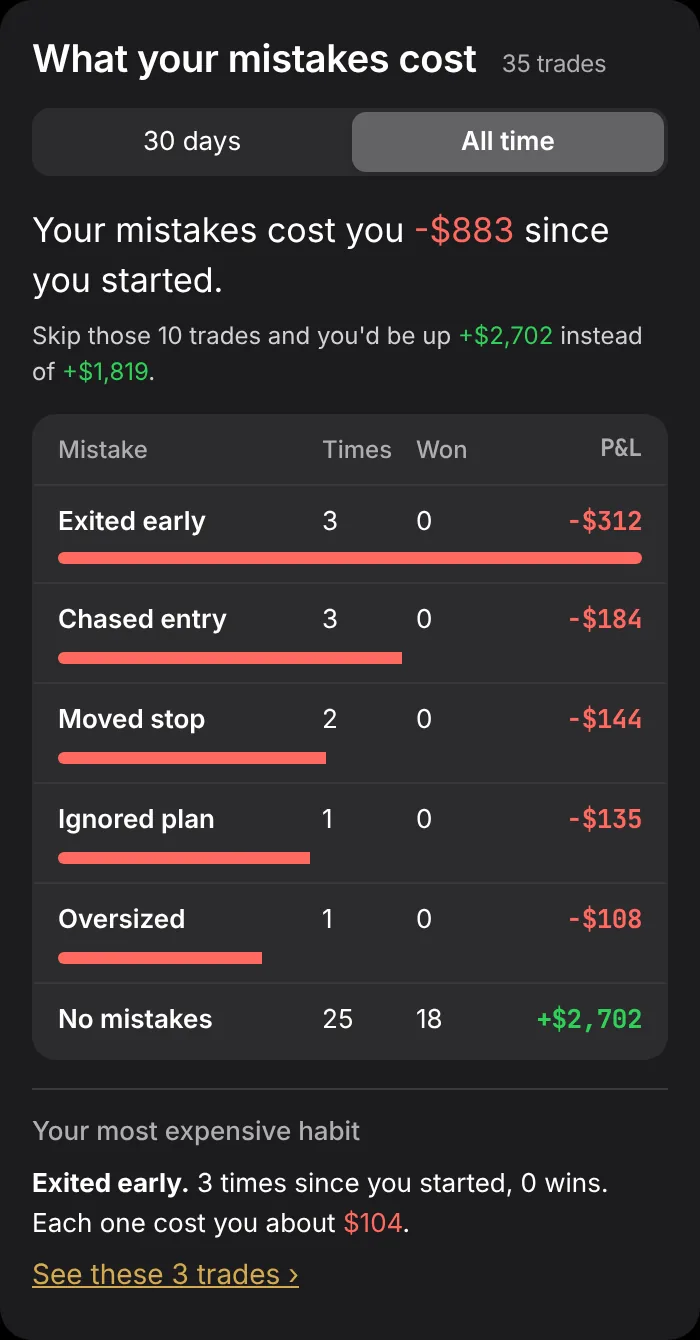
Here's what that looks like for a made-up set of 35 trades:
| Mistake | Trades | Won | P&L |
|---|---|---|---|
| Exited early | 3 | 0 | −$312 |
| Chased entry | 3 | 0 | −$184 |
| Moved stop | 2 | 0 | −$144 |
| Ignored plan | 1 | 0 | −$135 |
| Oversized | 1 | 0 | −$108 |
| No mistakes | 25 | 18 | +$2,702 |
In this example, the trades with mistakes lost $883 in total, while the trades with no mistakes made $2,702. Exiting early was the most expensive habit: three times, about $104 each.
It's a simple measure: a trade with a mistake might have lost anyway. But over many trades, it shows you where to look.
Work on one mistake at a time
Pick your most expensive mistake, add one rule to your setups that guards against it, and watch that number over your next 20 trades. When it shrinks, move on to the next one.
Mistakes often travel with feelings: revenge trades with frustration, chased entries with FOMO. Tagging how you felt when you entered helps you spot those pairs. See what to write in a trading journal.
In A+ Traders Journal
Tag mistakes with one tap when you log a trade. The Dashboard's “What your mistakes cost” panel adds them up, names your most expensive habit, and links to the trades behind it.