How to grade your trades A+ to F
Most traders judge a trade by one thing: did it make money? But a trade can follow every rule and still lose, and a trade can break every rule and still win. Grading each trade by how well you followed your own plan gives you something you can control, and over time it shows whether your rules are worth following.
Why grade the process, not the profit
The result of a single trade is partly luck. If you only look at the money, two things go wrong:
- Lucky trades teach bad habits. You chase an entry, it works, and next time chasing feels fine.
- Good trades feel like mistakes. You follow your plan, the stop gets hit, and you start doubting rules that may be working over many trades.
A grade splits one question into two: Did I trade my plan? and Does my plan work? You answer the first one on every trade. You answer the second one later, from your numbers.
Step 1: Write your setup as a short checklist
A setup is the kind of trade you look for, written down as rules. Keep it to three to six rules, and make each one something you can answer with a plain yes or no at the moment you enter.
| Vague | Checkable |
|---|---|
| Strong move | Price breaks the first 15-minute range |
| Good volume | Volume is above average on the break |
| Wait for confirmation | The retest holds the range |
| Don't risk too much | Stop under the range, risk 1R or less |
If you can't tell whether a rule was there without knowing how the trade ended, rewrite it.
Not sure where to start? Here are four common setups written as checklists that you can change to fit how you trade.
Step 2: Tick only what was really there
When you log the trade, go through the checklist and tick each rule that was true when you entered. Be strict: “almost” is a no. And tick it the way you saw it at the entry, not with hindsight from how the trade turned out.
Better still, run the checklist before you enter. If a rule is missing, you can wait for it, or take the trade knowing it isn't an A+.
Step 3: Turn the checklist into a grade
Count the rules you missed:
| Grade | What it means |
|---|---|
| A+ | Every rule followed |
| A | One rule missed |
| B | Two rules missed |
| C | Three or more rules missed |
| F | None of the rules were there |
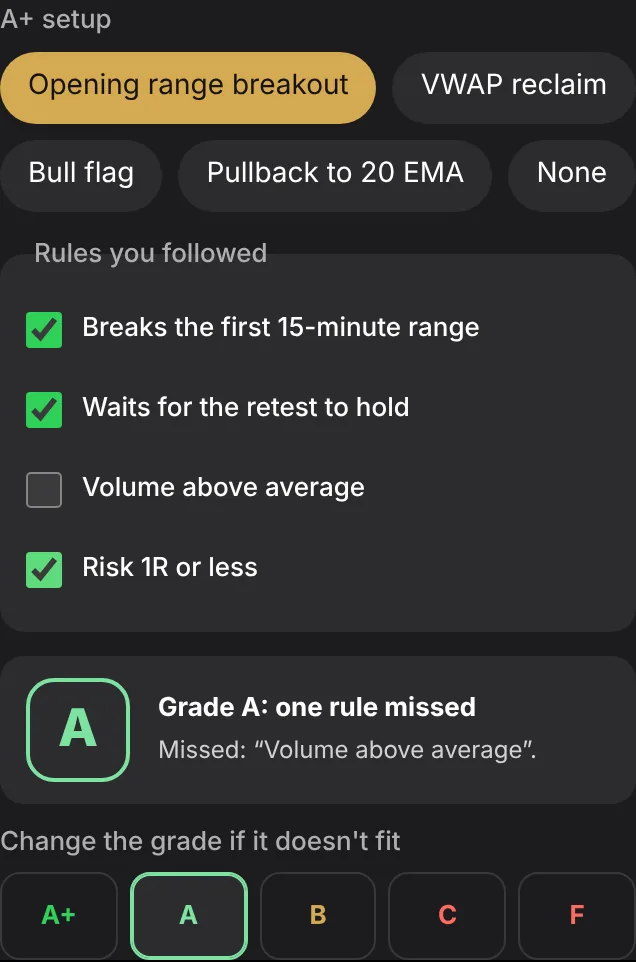
Example. Your opening range breakout setup has four rules. On today's trade, price broke the range, the retest held and your stop was in the right place, but volume was below average. That's three of four: grade A, one rule missed.
The grade is about your entry and your plan, not the result. An A+ trade that hits its stop is still an A+ trade.
Step 4: Compare your A+ trades with the rest
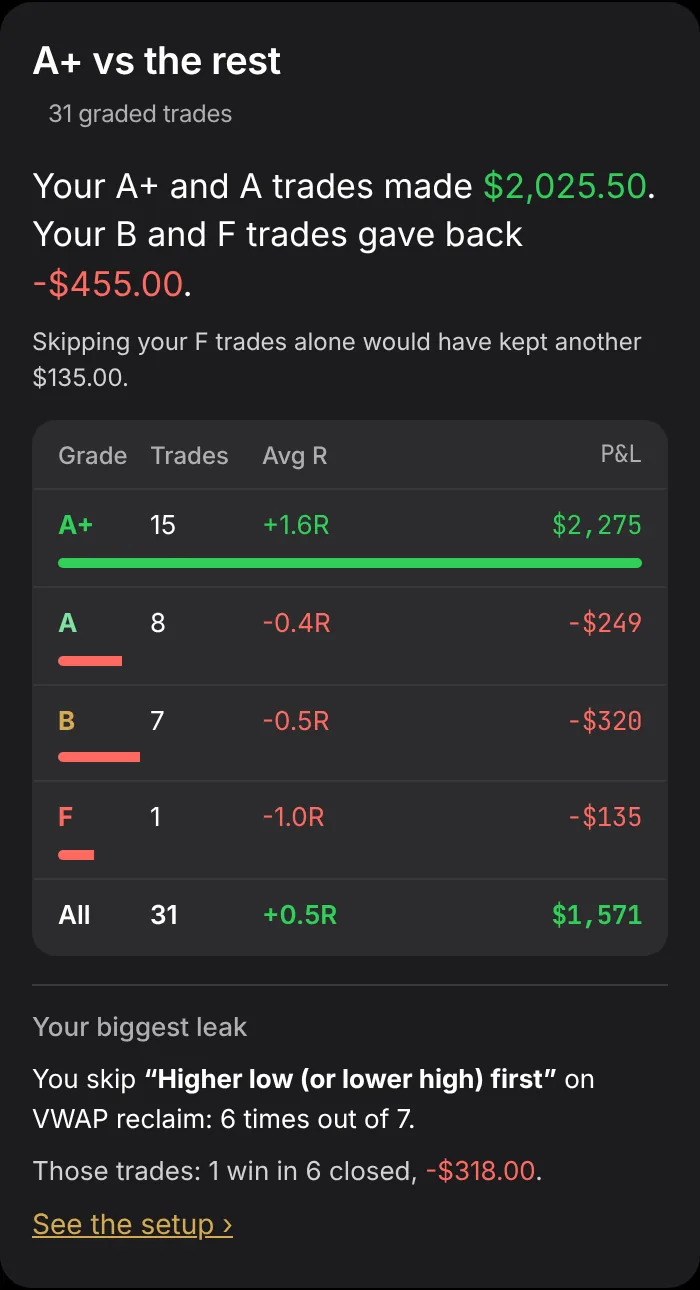
After 20 or 30 graded trades, group them by grade and look at four numbers for each group: the number of trades, the win rate, the average R, and the total profit or loss.
Then ask yourself:
- Do my A+ trades do better than my B and C trades? If they do, the rules are earning their place, and the job is to take more A+ trades and fewer of the rest.
- Which rule do I skip most often? One rule tends to show up again and again. That's the habit to work on.
- What do my F trades add up to? Trades that matched none of your rules are worth watching on their own.
If your A+ trades don't do better than the rest, that's useful too: one of the rules may not matter, or something important is missing from the list. Change one rule at a time, so you can see what made the difference. And remember that a handful of trades proves nothing either way; look at the pattern over many trades.
Common questions
What if the grade feels wrong?
Change it, and write a short note on why. If you keep changing the same kind of grade, the checklist probably needs a new rule, or a clearer one.
Can I grade trades without a written setup?
Not really: without rules, there's nothing to grade against. Start with one setup, the one you trade most, and add others later.
How many rules should a setup have?
Three to six is a good range to start with. With fewer, the grade says little. With more, you won't check them all in the moment.
Doing this in A+ Traders Journal
A+ Traders Journal does the counting for you. Write down your setups and their rules (or start from a ready-made one), pick the setup when you log a trade, and tick the rules that were there. The grade appears as you tick, and you can change it if it doesn't fit.
The Dashboard's “A+ vs the rest” panel then shows the trades, average R and profit or loss for each grade, and which rule you skip most.