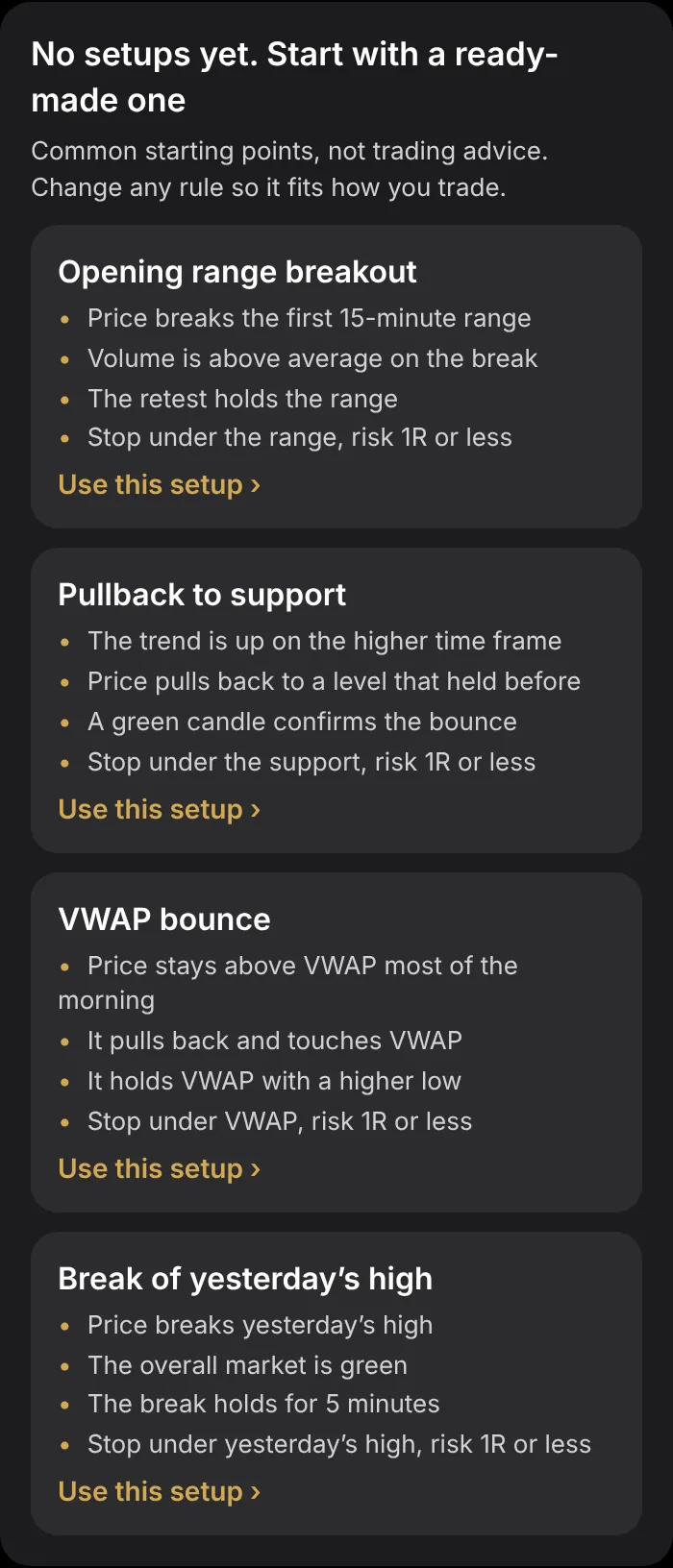
4 common day-trading setups, written as checklists
A setup is only useful if you can tell, before you enter, whether it's really there. Below are four setups many day traders know, each written as four yes-or-no rules. Use them as a starting point, and change any rule so it fits how you trade.
How to read these checklists
Each setup has four rules: three about the entry and one about risk. They're written for a long trade (buying). For a short trade, flip them: the low of the range instead of the high, below VWAP instead of above, and so on.
1R is the amount you normally risk on one trade, for example $50, or 1% of your account. “Risk 1R or less” means the stop is placed so that, at your size, this trade can't lose more than that.
Each setup also comes with a few things you have to decide for yourself, because the answer depends on what you trade, your time frame and your account.
1. Opening range breakout
The opening range is the high and low of the first minutes of the trading day, often the first 5, 15 or 30 minutes. The idea: when price breaks out of that range with real interest behind it, it may keep going in that direction.
- Price breaks the first 15-minute range
- Volume is above average on the break
- The retest holds the range
- Stop under the range, risk 1R or less
Decide for yourself: how long your opening range is; whether a break means a candle closing outside the range or just a touch; what “above average” volume means to you (for example, more than the average of the last 20 candles); and whether you wait for the retest or enter on the first break.
Watch out for: chasing a break that's already far from the range. The further price runs before you get in, the further away your stop is, and the bigger your risk.
2. Pullback to support
In an uptrend, prices rarely go straight up. A pullback setup waits for price to dip back to a level where buyers stepped in before, such as an earlier high, a moving average or a round number, and buys when it starts to bounce.
- The trend is up on the higher time frame
- Price pulls back to a level that held before
- A green candle confirms the bounce
- Stop under the support, risk 1R or less
Decide for yourself: which higher time frame you check (for example, the daily chart for a swing trade, or the hourly chart for a day trade); what counts as a level that “held before”; and what confirms the bounce for you.
Watch out for: buying a “pullback” that is really the start of a downtrend. That's what the first rule is for.
3. VWAP bounce
VWAP, the volume-weighted average price, is the average price of everything traded so far today, weighted by how much traded at each price. It starts fresh every morning. Many intraday traders read price above VWAP as buyers being in control for the day so far.
- Price stays above VWAP most of the morning
- It pulls back and touches VWAP
- It holds VWAP with a higher low
- Stop under VWAP, risk 1R or less
Decide for yourself: what “most of the morning” means (for example, above VWAP for the first hour); how close counts as a touch; and which chart you watch for the higher low.
Watch out for: price chopping back and forth across VWAP. If it can't stay on one side, the line isn't telling you much.
4. Break of yesterday’s high
Yesterday's high is a price almost every trader can see on their chart, so many of them watch it. This setup buys when price breaks above it, and waits a few minutes to see the break hold.
- Price breaks yesterday’s high
- The overall market is green
- The break holds for 5 minutes
- Stop under yesterday’s high, risk 1R or less
Decide for yourself: what “the overall market is green” means to you (for example, the S&P 500 above yesterday's close); how long the break must hold; and whether a quick dip back under the high cancels the trade.
Watch out for: false breaks that pop above the high and fall straight back under it. The “holds for 5 minutes” rule is there to filter out some of them.
Rules many traders add to any setup
Entry rules are only part of a plan. These are rules traders often add to every setup. Pick the ones that fit you, and skip the rest.
Before the entry
- Trading with the trend on the higher time frame
- Price is at a key level
- Volume confirms the move
- Waited for the candle to close
- Waited for the retest
- No big news in the next 30 minutes
Risk
- Stop loss set before entering
- Risk 1% of my account or less
- Reward is at least 2 times the risk
- Size worked out from my stop
Managing the trade
- Did not move my stop further away
- Took partial profit at the first target
- Let the winner run to my target
Daily rules and mindset
- Not after 2 losses in a row
- Within my max loss for the day
- No more than 3 trades today
- Not a revenge trade
- Calm and focused when I entered
Make it yours, then test it on your own trades
Write the setup down, trade it, and tick the rules that were really there on every trade. After 20 or 30 trades, compare the trades where every rule was there with the ones where you skipped something. That tells you more about the setup than any article can. Here's how to grade your trades A+ to F.
Change one rule at a time, so you know what made the difference.
These setups are built into A+ Traders Journal
In A+ Traders Journal, a new journal offers these four as ready-made setups. Tap one to use it as it is, change any rule, or add rules from the list of common ones. Every trade you log is then graded against the rules.