What to write in a trading journal (a simple template)
A trading journal only helps if you keep it up. So the goal is simple: write down the few things that teach you something, and nothing else. Here's what to record for every trade, what to review each week, and a template you can copy.
For every trade: the facts
- Date, and the times you entered and exited
- Symbol, and whether you were long or short
- Entry, exit and stop prices
- Size: shares or contracts
- Setup: which of your setups this was, or “none”
- A screenshot of the chart, if you can. Weeks later, it shows you what you saw.
The numbers to work out
- Profit or loss. For a long trade: (exit − entry) × size. For a short trade: (entry − exit) × size. For futures, multiply by the contract's dollar value per point.
- R-multiple. Your profit or loss divided by what you planned to risk (the distance from entry to stop, times your size). A trade that made twice your planned risk is +2R. R lets you compare trades of different sizes.
- Outcome: win, loss or breakeven.
The honest part (most journals skip it)
This is where the learning is.
- Rules followed. Tick each rule of your setup that was really there when you entered. The count gives you a grade from A+ to F. See how to grade your trades.
- Mistakes. Moved stop, oversized, revenge trade, ignored plan, chased entry, exited early, or none. See common trading mistakes and what they cost.
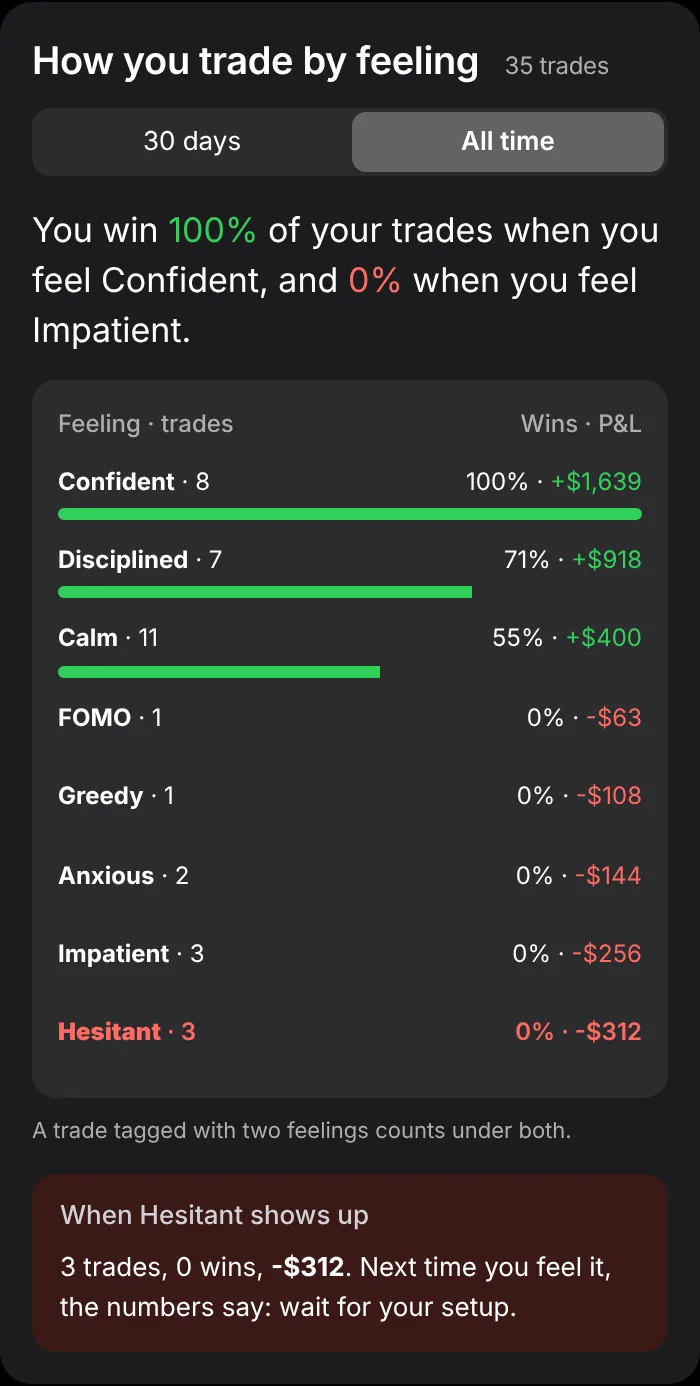
- How you felt when you entered. For example: confident, calm, disciplined, anxious, FOMO, impatient, greedy or hesitant.
- One or two lines of notes: why you took the trade, and what you'd do differently.
Once a day: a short reflection
At the end of the day, write a few lines about you, not the trades: your mood, what went well, and one thing to change tomorrow. Over the weeks, it shows patterns the trades alone don't, like how you trade after a bad night's sleep.
Once a week: a review
Set aside 15 minutes and answer five questions:
- How did my A+ trades do compared with the rest?
- Which rule did I skip most often?
- Which mistake cost me the most?
- Which feeling did I trade worst with?
- What's the one thing I'll do differently next week?
A template you can copy
Copy this into a notebook, a note on your phone or a spreadsheet, one per trade:
TRADE
Date:
Entry time:      Exit time:
Symbol:          Long / Short
Entry:           Exit:
Stop:            Size:
Setup:
P&L:             R:
Win / Loss / Breakeven

RULES (tick only what was there)
[ ]
[ ]
[ ]
[ ]
Grade:  A+   A   B   C   F

MISTAKES
[ ] Moved stop
[ ] Oversized
[ ] Revenge trade
[ ] Ignored plan
[ ] Chased entry
[ ] Exited early
[ ] No mistakes

Feeling at entry:
Why I took it:
What I'd do differently:
Keep it fast
If logging a trade takes more than a minute or two, you'll stop doing it. Write the facts and the honest part right after the trade, while you still remember, and leave the deep thinking for the weekly review.
Or let the journal do the math
A+ Traders Journal works out the profit or loss, R and outcome for you (futures contract values included), grades the trade against your setup as you tick the rules, and adds up your mistakes and feelings on the Dashboard.